On a crowded Pittsburgh sidewalk, taking a photograph is usually straightforward. Uploading that image to an AI service that recognizes a face, connects it to a name, and adds a workplace or social profile is a different act. The question “does ai need consent to identify names in photos” sounds simple, but the answer depends on the tool, the setting, the person being identified, and the law that applies.
The short version is that consent is often the responsible standard, and in some situations it is legally required. It is not always required merely to photograph someone in a public place. Identification changes the privacy analysis because it turns an ordinary image into searchable information about a particular person.
A photo is not the same as an identification
A camera can capture a face without knowing who the person is. An AI system that matches that face against a database, social network, employee directory, or public website performs another operation. It creates an inference about identity, and that inference can be wrong, difficult to correct, and surprisingly persistent.
This distinction helps answer does ai need consent to identify names in photos. The issue is not simply whether a person appeared in the frame. It is whether a company or individual is using biometric or personal information to attach a name to that face. A photo from a parade might be harmless documentation. A searchable list of attendees, generated without their knowledge, carries more serious consequences.
Accuracy also matters. Face-matching systems can produce false matches, particularly when the image is dark, distant, partially blocked, or captured at an unusual angle. A confident-looking label is not proof. If a name is attached to a photo, anyone relying on it should verify the result through a separate source before taking action.
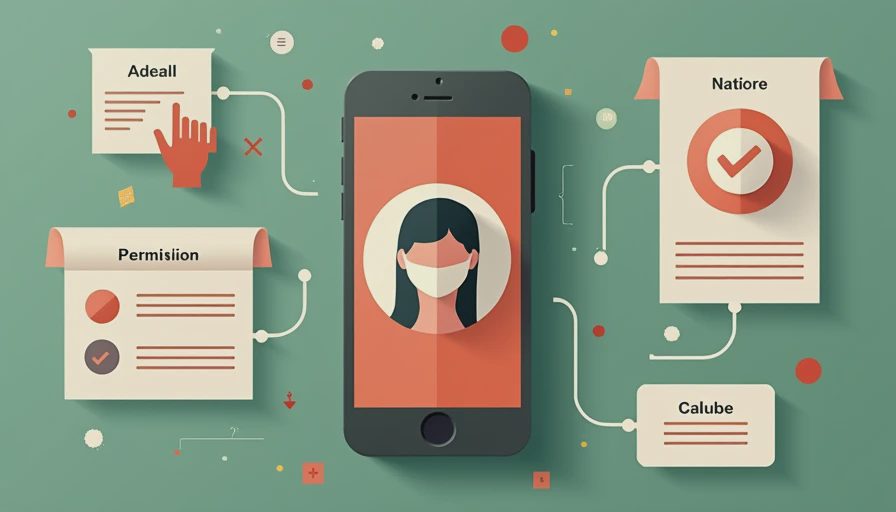
What US privacy law generally considers
There is no single federal US law that provides one universal answer to does ai need consent to identify names in photos. Instead, several legal frameworks can overlap. State biometric privacy laws may regulate the collection, storage, or use of face geometry and other biometric identifiers. Illinois, Texas, and Washington are among the states with laws addressing biometric information, though their requirements differ.
Illinois is especially important because its Biometric Information Privacy Act, commonly called BIPA, has been used in lawsuits involving facial recognition. The law can require notice and written consent for certain collection or use of biometric identifiers. Whether a particular image-analysis activity falls within a law depends on facts such as the data collected, the company involved, and where the person is located.
State comprehensive privacy laws may also give people rights involving sensitive personal data, profiling, access, deletion, or opting out. Those statutes are not interchangeable, and exemptions can apply to employment, journalism, government activity, or publicly available information. A business should obtain advice from a qualified privacy lawyer before building an identification feature around customer images.
Public places do not erase every privacy expectation
People generally have less privacy in a public street, airport terminal, concert crowd, or store than inside a private home. That does not mean every use of a public photograph is automatically acceptable. A person might reasonably expect a local newspaper to publish a wide crowd image while not expecting a retailer to scan the same crowd and create customer profiles.
The purpose and scale of the activity matter. A one-time editorial image is different from continuous surveillance. A small club labeling photographs for members is different from a platform indexing millions of faces. The answer to does ai need consent to identify names in photos becomes more cautious when identification is invisible, commercial, continuous, or shared with other organizations.
Notice can improve the situation, but notice is not always consent. A sign that says “facial recognition in use” may inform visitors without giving them a meaningful choice. Responsible systems explain what happens, why it happens, how long data is kept, and how a person can challenge or remove an incorrect result.
When consent is the sensible default
Consent is the clearest path when an image will be used to identify employees, students, patients, customers, event attendees, or members of a private group. It should be specific rather than buried in a long terms-of-service document. A useful request might explain that an image will be analyzed to suggest a name, that the suggestion can be wrong, and that declining will not block access to an unrelated service.
For children, the standard should be higher. Schools, youth organizations, and software vendors should avoid treating a parent’s general permission for photography as automatic permission for face identification. Children may also be covered by additional privacy rules, depending on the service and the context.
The practical answer to does ai need consent to identify names in photos is often yes when the person can be identified and the result will affect access, employment, safety, reputation, or money. Consent does not fix every design problem, but its absence makes the burden of justification much heavier.

Safer alternatives for ordinary users
Many people do not need identity recognition at all. If the goal is to organize a family album, use manual labels or ask relatives to add their own names. If the goal is event networking, provide an opt-in attendee directory instead of scanning faces. If the goal is accessibility, describe visible clothing, objects, or scene details without guessing a person’s name.
A business testing an image tool can reduce risk with several technical choices. Process images locally when possible. Avoid sending full-resolution files to a third party. Keep raw images for the shortest practical period. Separate face embeddings from account details. Restrict access through role-based permissions. Record when a match was suggested and who approved it. Most importantly, do not use an AI label as the sole basis for discipline, denial of service, police referral, or another high-impact decision.
Users should read the product’s privacy documentation before uploading images. Look for retention periods, training-use statements, deletion controls, vendor sharing, and whether human reviewers can see the files. Free tools often have an economic model built around data, advertising, or service improvement, so “free” is not the same as consequence-free.
A simple decision process before uploading a photo
Start by asking what you are trying to accomplish. If naming people is not essential, remove the identification step. If it is essential, ask whether each person has agreed and whether that agreement is documented. Next, identify the data involved: a visible face, a biometric template, a name, a workplace affiliation, or a sensitive characteristic. The more pieces combined, the greater the risk.
Then check the location and audience. An image stored privately on a phone presents a different exposure from one sent to a cloud vendor or published online. Review the tool’s deletion settings and test whether deleting an image also deletes derived face data. Finally, create a correction route. A person who has been mislabeled should be able to report the error and receive a timely response.
That process does not produce a universal legal answer, but it makes careless identification less likely. It also gives managers a record of why a system was used, what safeguards were selected, and what happened when the technology failed.
The facts, the inference, and the judgment
The facts are these: photographing people and identifying people are different activities; face recognition can create sensitive information; US privacy rules vary by state and context; and AI matches can be wrong. The phrase does ai need consent to identify names in photos therefore cannot be answered with a single nationwide yes or no.
The inference is that hidden, commercial, repeated, or high-impact identification deserves the strongest consent and oversight. Public availability of a face is not the same as permission to turn that face into a permanent index entry.
My judgment is more practical than dramatic: if you would feel the need to explain the system after someone discovered it, explain it before using it. Ask first, collect less, retain less, and give people a real way to refuse or correct the result. The facts end here. The inference ends here. The judgment is yours.





No letters yet — pray write the first.