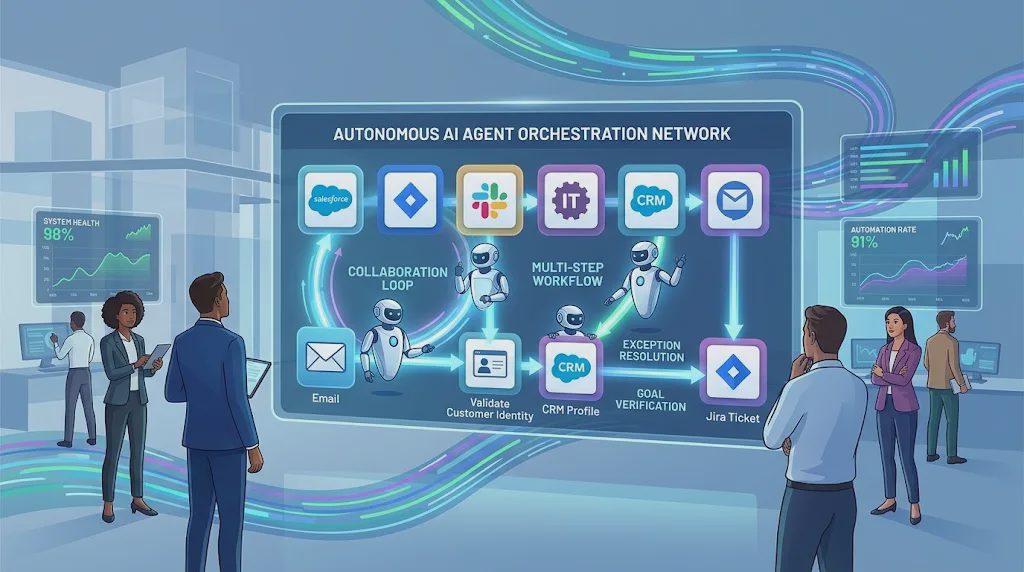
Autonomous AI agents are software systems that receive a business goal, break it into steps, pull relevant context from company data, call tools and APIs, and complete the work. They escalate to a human only when risk or an unusual case appears.
They sit apart from chatbots, RPA, and ordinary AI assistants. Chatbots follow scripts and fail outside them. RPA runs fixed sequences and breaks when an interface changes. Assistants generate answers but leave the actual work to people. Agents reason through exceptions and finish multi-step tasks across systems.
Clear Differences
Technology | Core Behavior | Decision Style | Action Level | Typical Business Use |
|---|---|---|---|---|
Autonomous AI agents | Plan and run multi-step processes across systems | LLM reasoning that adapts | High (API calls, record updates, tickets) | End-to-end IT incidents or CRM flows |
Chatbots | Scripted dialogue | Keyword or limited routing | Low | Tier-1 FAQ deflection |
RPA | Fixed click or API scripts | Rigid if/then rules | High but brittle | Legacy data entry or invoice scraping |
AI assistants | Generate text or answers on request | Prompt-driven only | Minimal | Drafting, summarizing, research |
The practical difference is resilience. An agent can read an unstructured customer email, identify three separate requests inside it, and handle each across backend systems without a pre-written decision tree.
How the Loop Actually Runs
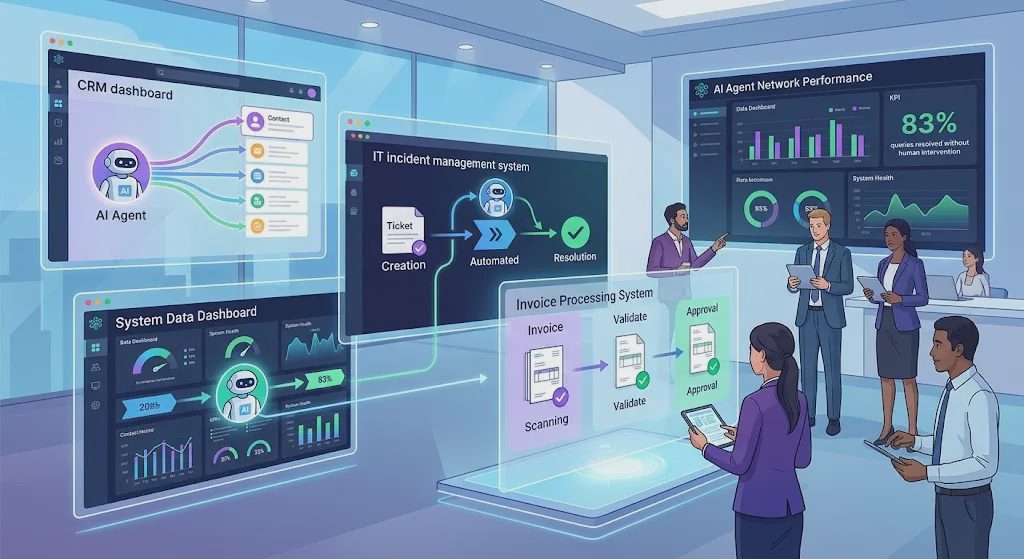
Most production agents follow a repeating cycle:
Receive a clear goal and set success criteria (for example, “refund issued and ticket closed”).
Retrieve live context from knowledge bases, CRM records, or documents, usually through retrieval-augmented generation.
Break the goal into ordered or parallel sub-tasks and map dependencies.
Select only the tools the agent is authorized to use and prepare the correct parameters.
Execute across connected applications—create tickets, update fields, trigger refunds, write notes.
Validate each result. On failure, retry, replan, or escalate.
Confirm the goal is met, log the full reasoning and action trace, and report the outcome.
The loop ends only when the goal is verified, not when the last API call returns. Multi-agent setups can hand specialized sub-tasks to different agents under a coordinator, but the same validation and escalation rules still apply.
Benefits Supported by Current Data
Processes that routinely break rule-based automation become workable because the agent reasons through exceptions instead of failing.
Microsoft’s internal baseline credits six minutes of productivity saved per tool use or reference by an agent.
Salesforce reports agents resolving up to 83% of customer queries without human intervention after launch.
Multi-application work (policy check + identity verification + CRM update) happens in one continuous flow instead of repeated system switching.
Decisions draw on current inventory, pricing, and policy data rather than static training data, which reduces avoidable errors.
High-volume, low-complexity work moves off human queues, lowering the cost of routine tasks.
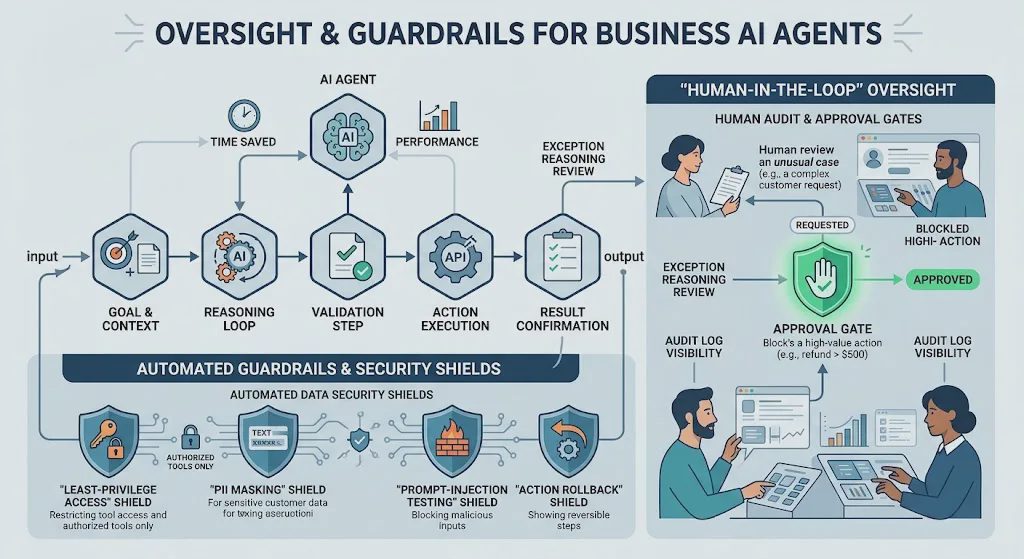
These gains appear only when the agent has reliable access to accurate, up-to-date context and when its actions remain visible and reversible.
Guardrails That Matter in Practice
Least-privilege access, approval gates for high-risk steps, and regular prompt-injection testing are required. Without them, an organization simply hands language models the keys to its systems. Full audit trails of every reasoning step and action remain essential for review, compliance, and debugging. Human-in-the-loop checkpoints for irreversible or high-value decisions keep risk manageable while still allowing the agent to handle the bulk of routine work.
A Practical Way to Begin
Select one measurable workflow. Record the current time, cost, and error rate. Deploy an agent against that single process. Expand only after the numbers improve and the audit logs stay clean. Broad programs that skip this baseline step rarely deliver reliable results.
In 2026 the useful distinction is no longer whether agents can act. It is whether they finish the job reliably, whether every step is visible, and whether the organization can control the risk.




No letters yet — pray write the first.